
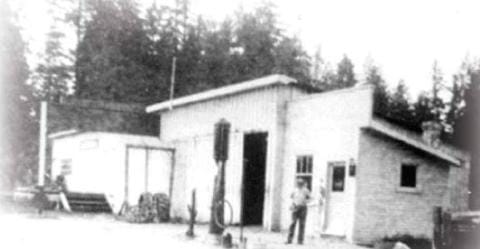
Austrian-born Ladislaus Hoffmann (1872-1952) and his wife, Emilie (1874-1970), came to Pitt Meadows in 1933, with their children Elfriede and Hans, after trading their orchard in Aldergrove with Jack Fairfi eld, who operated a garage and blacksmith shop on this property. The building that presently occupies the site was built in 1936 over top of the old building, and some of its features remain within the present building. The Hoffmanns operated a machine shop and later a drainage business from this building. Their son, Hans Hoffmann, was the first Fire Chief, built Pitt Meadow’s first fire truck, and allowed his building to be used as the town’s fire hall. Hans also developed three ditching machines that by 1955 helped drain the land in the north of Pitt Meadows, as well as other communities in the Lower Mainland.
The Hoffmann and Son Shop is a distinctive, open-plan structure with several large garage doors, and a flat roof with raised rounded parapets on three sides, reminiscent of a frontier-style false front building. The roof extends over an open service area at the front. Typical of family-operated businesses, the Hoffmann’s house was located on the property adjacent to the shop. Built in 1946, it is a modest one-storey structure with a cross-gabled roof. At the back of the site is a Quonset Hut, which was placed on the Hoffmann property in 1956 for the storage of large machinery related to the Hoffmann’s ditching and drainage business. These huts were developed by the U.S. Navy in 1941 as an all-purpose, lightweight and portable prefabricated structure that could be easily assembled with unskilled labour. After the war the huts were sold as surplus and were used across North America for a surprising variety of purposes, including conversion into residences. Although increasingly rare, some Quonset Huts still survive in the Lower Mainland in commercial and industrial use.
In 1999 Hans Hoffmann and his sister, Elfriede, donated the property, building, equipment and a vintage engine collection to the Pitt Meadows Museum Society, and in 2002 the family home was donated to the Municipality to be used as a park caretaker’s residence. Behind the workshop, land donated by the family is now called Hoffmann Park, preserving a splendid stand of old trees, which has become a prominent community landmark, and a welcome green area for nearby residents.