
The City of Pitt Meadows is exploring potential changes to the agricultural regulations in the Zoning Bylaw, and we want to hear from community members on the changes being considered. The proposed changes to the Zoning Bylaw aim to simplify and clarify City regulations and preserve the use of agricultural land for agricultural purposes.
Agricultural land in Pitt Meadows is a valuable resource. We are committed to strengthening the long-term sustainability of agriculture by supporting the preservation of farmland for farming and enhancing the viability of the agriculture sector through improved regulations.
Agricultural land is regulated by the Agricultural Land Commission (ALC) and the City. The ALC administers regulations governing the Agricultural Land Reserve (ALR)—a provincial land use designation where agriculture is the priority use. City regulations must be consistent with the ALC regulations. Through the Zoning Bylaw, the agricultural area is divided into zones that set regulations for how the land can be used as well as the size and location of buildings and structures.
A summary of the key changes to the Zoning Bylaw that are being explored are as follows:
Potential Change #1: Combine the General Agricultural A-1, Large Lot Agricultural A-2, and Agricultural and Farm Industrial A-3 zones into one zone.
- The agricultural area is currently divided into different zones that regulate the use of the land and the size and location of buildings and structures. Given that the A-1, A-2 and A-3 zones all include similar regulations, the City is considering combining these three zones into one zone to provide consistent regulations.
- The key change will be to establish a consistent minimum lot size of 16 ha (40 acres) for future property subdivisions. This will only affect the current A-1 and A-3 zones, which have a minimum lot size of 8 hectares (20 acres) for future property subdivisions; the A-2 zone already has a minimum lot size of 16 hectares (40 acres). This minimum lot size ensures the widest range of options are available for agricultural production and discourages the use of agricultural land for rural residential (i.e., estate home) purposes. It is noted that existing City policies already discourage subdivision in the agricultural area, as research shows that larger farm parcels are more likely to be actively farmed. Agricultural Land Commission (ALC) approval is also required for subdivisions in the Agricultural Land Reserve.
- To find what zone is currently applicable to your property, please use the Pitt Meadows Map Viewer and search for your address to find your current zoning. Refer to the Zoning Bylaw for the regulations applicable to that zone.
Potential Change #2: Update regulations related to on-site parking and vehicles.The City is considering some revisions to reinforce that agricultural land cannot be used for parking and storing non-farm vehicles. These proposed revisions include:
- Adding a clarifying definition for “farm vehicle” to accommodate legitimate agricultural uses and discourage use of agricultural land for non-farm vehicle storage and parking.
- Limiting recreational vehicles (including boats, camping trailers, recreational trailers) to a maximum of four on lots less than eight hectares (20 acres) and a maximum of six on lots eight hectares (20 acres) or larger; and clarifying that recreational vehicles cannot be kept for gain, rent or sale (i.e., property owners cannot charge others to store RVs). Currently, the Zoning Bylaw only permits the storage of recreational vehicles for personal use, with no limitation on the number.
- Clarifying that unlicensed, non-agricultural vehicles are only permitted if they are stored in an enclosed residential garage (either attached to a single-family house or in a detached garage).
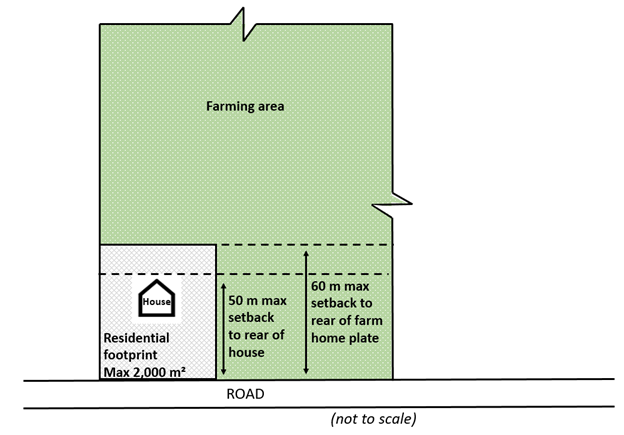
Proposed Change #3: Implement residential footprint (i.e., farm home plate) regulations.
- To preserve more farmland for farming and reduce the impact of residential development, the City is considering implementing residential footprint regulations.
- These regulations would define the dimensions for the areas on agricultural properties in which new homes, accessory residential buildings and yards can be developed.
- All new residential uses on an agricultural property will be contained within one area, close to the road (similar to the image below).
- Existing homes, garages and other residential uses built with valid building permits and approvals will not be affected by this change.
Proposed Change #4: Reduce the maximum size of new homes on smaller parcels
- Larger homes —especially on smaller lots —increase the costs of those properties, making it more challenging for farmers to afford land.
- Current regulations permit a maximum of 500 m² (5,381 ft²) in floor area for homes, which is consistent with the ALC regulations.
- For parcels less than eight hectares (20 acres) in size, the City is considering implementing a maximum of 400 m² (4,305 ft²) in floor area.
- No change is proposed for parcels eight hectares (20 acres) in size and larger (i.e. the maximum of 500 m² (5,381 ft²) in floor area would remain).
Proposed Change #5: Remove allowance for garden suites on parcels smaller than 8,094 m² (two acres) in size.- A garden suite is a detached, self-contained dwelling unit located on the same parcel as a single-family home.
- Current City regulations for agricultural zones only permit garden suites on parcels eight hectares (20 acres) in size and larger, except on parcels less than 8,094 m² (two acres) where ALC use regulations may not apply.
- The City is considering removing the allowance for a garden suite from those parcels less than 8,094 m² (two acres), to protect more farmland from expanding residential development and directing growth to the urban area where community services and amenities are located.
- Attached secondary suites would still be permitted in single-family homes.
- These changes would not impact regulations for temporary farm worker housing; see Proposed Change #6 below.
Proposed Change #6: Simplify temporary farm worker housing regulations.
To make it easier and more flexible for legitimate farm operations to provide housing for their workers, the City is considering some simplification and updates to the temporary farm worker housing regulations. These include:
- Removing the minimum lot size required for the location of the housing.
- Simplifying the maximum number of farm workers that can be accommodated on a single property to:
- 130 for greenhouse, mushroom, tree fruit and berry/vegetable production
- 40 for all other commodities
- These limits are consistent with the ALC criteria for CEO delegated decision-making regarding temporary farm worker housing.
- Increasing the maximum housing floor area per worker to 13 m2 (140 ft2)
Please note: the Zoning Bylaw includes additional regulations affecting the use of agriculture-zoned properties. The above questions address some of the key changes that are currently being considered by the City. The Zoning Bylaw can be viewed in its entirety at pittmeadows.ca/bylaws.
Engagement Opportunities
The City sought feedback from the public via a survey, which was open from September 10 to October 13, 2025. Thank you for sharing your feedback, it will help to inform the potential changes moving forward.
- Talk to a City Planner: Allison Dominelli, 604-465-2433 or adominelli@pittmeadows.ca.
Additional Resources
- Read the Engagement & Priorities Committee Meeting report, presented to Council and the community on April 8, 2025.
- Read the report and watch the presentation at the Agricultural Advisory Committee meeting on February 13, 2025.